
Banking shares saw a renewed buying interest on the hopes of a rate-cut by the central bank post the easing of macro-economic data.

'And a majority will be in the top-end vehicle range.'

'To the believers of crypto regulations, I have only one question to ask, how will you regulate it?'

On Monday, Reserve Bank hiked the lending rates to banks by 2 per cent to 10.25 per cent.

Year-to-date, the rupee is the worst-performing currency in Asia, weakening 4.184 per cent against the US dollar.

The seasonally adjusted IHS Markit India Manufacturing Purchasing Managers' Index (PMI) fell from 58.9 in October to a three-month low of 56.3 in November, indicating that the manufacturing sector growth remained strong, despite losing traction.

Emerging market currencies including Indian rupee are likely to remain under pressure, though depreciation is expected to slow from here, Barclays said in a research report.

So which sectors are likely to do well in 2022? Should you focus on domestic economy-related sectors or export-oriented ones?

The rupee gained 28 paise on Thursday to close at 62.50.

Rupee hits 2-month low, down 21 paise against dollar.

Hero MotoCorp, Bajaj Auto, M&M and Tata Motors were the major winners.

Falling for the third day, Indian rupee on Wednesday weakened by 14 paise to close at over one-week low of 62.02 against the Greenback.

The rupee on Tuesday fell by 25 paise to 65.05 on fresh dollar demand from banks and importers despite persistent foreign capital inflows.
.jpg)
The Reserve Bank of India sold dollars via state-owned banks around 62.3575 per dollar to contain the rupee's fall, traders said.

The rupee has depreciated by about 25 per cent in the past three months, from close to Rs 83 in mid-May, while it was even higher at about Rs 80 against the British Pound in March.

'Consumers are willing to increase travel spends by 20-30 per cent versus pre-pandemic.'

We are much better placed than in 2013 with our overall fundamentals much stronger - higher foreign exchange reserves, a more favourable growth-inflation mix and an institutional framework for targeting inflation, says B Prasanna.

India's forex reserves increased by $6.31 billion to $584.76 billion for the week ended April 7, the RBI said on Friday. In the last reporting week, the forex kitty snapped a two-week rising trend to decline by $329 million to 578.45 billion. It can be noted that in October 2021, the country's forex kitty reached an all-time high of $645 billion.

Foreign institutional investors pulled out Rs 86.66 crore (Rs 866.6 million) from local stocks on Monday, as per provisional BSE data.

While the rupee depreciation in 2012 persuaded many companies in taking hedges against their foreign currency loans, industry analysts feel it might not be sufficient to counter the swift slide in the value of the local currency.

After years of being sequestered by the pandemic, some intrepid travellers are planning to settle their score with the novel coronavirus. With fewer or no travel curbs, they are eager to get back on the road, again. Hotels and tour operators, too, are eager to shed excess Covid baggage. And this year's Diwali promises to add that extra layer sparkle with the introduction of new flights.

Students going abroad could look at options like paying tuition fee in one go, as that can get discounts.

Increased demand from oil importers for the American currency kept pressure on the rupee
Foreign fund inflows and a higher opening in the domestic equity market supported the domestic unit
Extending losses for the fourth straight session, Indian rupee on Monday declined by ten paise to log over 13-month closing low of 63.67.

If the rupee falls further, it would negatively impact the dollar-based returns of foreign investors, and could influence foreign flows into India.

If you plan to send your child to the US five years from now and expect the rupee to depreciate five per cent every year, adding US funds to your portfolio might be a good idea, says Ashley Coutinho.

The rupee had plummeted to over three-month low of 63.32.

A fall in the rupee could boost exports. But the flip side of the equation is that a weaker rupee could stoke some inflation

According to HSBC, the 'storm has abated' for the Indian markets as the US Fed has deferred tapering of its quantitative easing stimulus, and as the new Reserve Bank of India Governor Raghuram Rajan has taken steps to contain the rupee fall.

India's foreign exchange reserves dropped $325 million to $560.942 billion as of February 24, making it the fourth consecutive week of decline in the kitty, the Reserve Bank of India said on Friday. In the previous reporting week, the overall reserves had declined $5.68 billion to $561.267 billion. In October 2021, the forex kitty reached an all-time high of $645 billion.

A 10 per cent-plus movement of currency in a few weeks is definitely concerning for the companies.
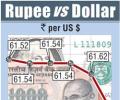
The rupee was largely rangebound for most of the trading day in the absence of any major cues ahead of the Reserve Bank of India's rate-setting meeting next week.
India's forex kitty rose by $12.80 billion to $572.80 billion in the week ended March 17, the Reserve Bank said on Friday. In the previous reporting week, the reserves had dropped by $2.39 billion to a three-month low of $560.00 billion. It can be noted that in October 2021, the country's forex kitty had reached an all-time high of $645 billion.

Decisions taken at home to counter impact of 2008 economic meltdown were among the reasons for depreciation of the Indian currency.

Telecom major Bharti Airtel on Wednesday reported a 29 per cent decline in consolidated net profit at Rs 512 crore (Rs 5.12 billion) for the quarter ended September 30, 2013, mainly on account of increase in finance cost and forex losses due to rupee depreciation.
Participatory Notes (P-Notes) are derivative instruments issued by FIIs to foreign investors -- individuals or corporates -- who want exposure to Indian equities, but do not want to register with Sebi.

Good performances by most information technology (IT) companies in the September quarter and improved forecasts notwithstanding, with the exception of Infosys, stocks of IT biggies such as TCS, Wipro and HCL Technologies have fallen three to nine per cent since Infosys announced its earnings on October 11.

Investors are anxious over the US-China trade tension, a sharp devaluation in yuan and uncertainty over Kashmir issue.

India's forex reserves dropped by $329 million to $578.45 billion for the week ended March 31, on decline in gold reserves, the RBI said on Friday. The forex kitty had risen handsomely in the previous two reporting weeks, and rose by $5.98 billion to $578.78 billion for the week ended March 24. For FY23, the overall kitty has dropped by $28.86 billion.
